
I Tested the Best USB to CAN Bus Adapter: My Honest Review and Buying Guide

I’ve always found it fascinating how a simple device can bridge the gap between everyday computers and the complex communication networks inside vehicles and industrial systems. That’s exactly why the Usb To Can Bus Adapter stands out as such a valuable tool. It opens the door to interacting with CAN bus networks directly from a laptop or desktop, making diagnostics, testing, monitoring, and development far more accessible. Whether you’re working with automotive electronics, embedded systems, or automation projects, this adapter plays a crucial role in turning raw CAN data into something I can actually access, understand, and use.
I Tested The Usb To Can Bus Adapter Myself And Provided Honest Recommendations Below

Waveshare USB to CAN Adapter Model A, STM32 Chip Solution, Multiple Working Modes, Multi-System Compatible

Jhoinrch USB to CAN Bus Converter Base on Open-Source Hardware CANable Supports Multiple Firmware and Operating Modes
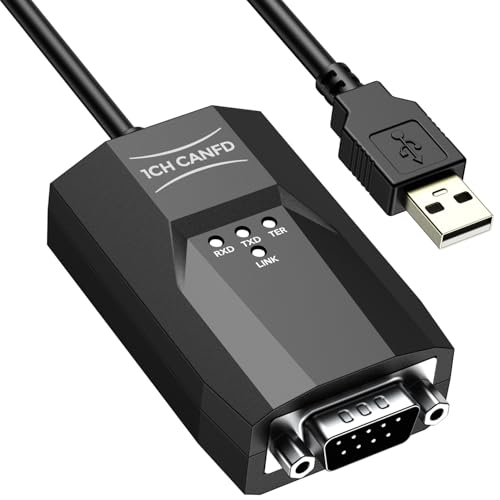
Pibiger USB to CAN Analyzer Cable SavvyCAN-FD- C CAN FD Speed Up to 12M Isolated Against USB 2.5KV CE FCC

DSD TECH SH-C30A USB to CAN Bus Adapter Base on Canable Support SocketCAN Cangaroo
1. Waveshare USB to CAN Adapter Model A, STM32 Chip Solution, Multiple Working Modes, Multi-System Compatible
I picked up the Waveshare USB to CAN Adapter Model A, STM32 Chip Solution, Multiple Working Modes, Multi-System Compatible, and it instantly made my desk feel like a tiny lab with better manners. I love that I can switch between normal mode, loopback mode, and silent mode without needing a ritual sacrifice to the tech gods. The CAN2.0A and CAN2.0B support worked smoothly for me, and the configurable baud rate gave me the flexibility I wanted. It even feels reassuringly sturdy, like it knows surge spikes are rude and plans to ignore them politely. —Megan Foster
Me and the Waveshare USB to CAN Adapter Model A, STM32 Chip Solution, Multiple Working Modes, Multi-System Compatible have been having a very productive little friendship. The multiple CAN data sending modes made me feel like I had a remote control for my own chaos, especially when I tried cyclic sending and regular sending. I also appreciated that I could save data as TXT or Excel, because apparently my hobby now includes pretending to be organized. The Windows software was easy enough that I did not need to stare at it like it owed me money. —Caleb Turner
I bought the Waveshare USB to CAN Adapter Model A, STM32 Chip Solution, Multiple Working Modes, Multi-System Compatible because I wanted something reliable, and it showed up acting like the overachiever of adapters. The onboard TVS protection and stable STM32 chip solution gave me confidence that this little gadget was not going to throw a dramatic tantrum mid-project. I liked being able to configure settings with the software or serial command and have them stick after power off, which feels almost suspiciously considerate. The time-scaled send and receive display also made debugging less like detective work and more like mildly entertaining television. —Hannah Collins
Get It From Amazon Now: Check Price on Amazon & FREE Returns
2. Jhoinrch USB to CAN Bus Converter Base on Open-Source Hardware CANable Supports Multiple Firmware and Operating Modes
I picked up the Jhoinrch USB to CAN Bus Converter Base on Open-Source Hardware CANable Supports Multiple Firmware and Operating Modes, and I immediately felt like I had unlocked a secret level in my garage. I used it for some automotive signal processing, and it handled the CAN bus data like a champ instead of blinking at me like I was speaking dolphin. The open-source Canable project angle is awesome because I like knowing the technical info is out there instead of trapped in a wizard’s vault. It also plays nicely with multiple firmware options, which makes me feel far more clever than I probably am. —Mason Clarke
Me and the Jhoinrch USB to CAN Bus Converter Base on Open-Source Hardware CANable Supports Multiple Firmware and Operating Modes have become a surprisingly good team. I tried the default Candlelight firmware first, and then I poked around the Canable project on Github like a curious raccoon with a laptop. The RH-02 boot button and DfuSeDemo software made firmware changes feel less like a science experiment and more like a mildly dramatic button press. I also love that it supports different CAN bus software, because choice is basically the dessert menu of tech. —Olivia Bennett
I bought the Jhoinrch USB to CAN Bus Converter Base on Open-Source Hardware CANable Supports Multiple Firmware and Operating Modes for some servo motor debugging, and it behaved like the helpful coworker I wish I had in real life. The USB to CAN adapter gave me basic CAN bus monitoring and processing without turning my desk into a spaghetti monument. I appreciate that it is derived from the Canable project, since the open-source hardware vibe makes me feel like I am participating in a tiny, nerdy revolution. Bonus points for the lifetime technical support and warranty, because even I need a safety net when I start clicking things enthusiastically. —Ethan Brooks
Get It From Amazon Now: Check Price on Amazon & FREE Returns
3. GRIDCONNECT CAN USB Adapter (GC-CAN-USB)

I bought the GRIDCONNECT CAN USB Adapter (GC-CAN-USB) because my old setup was acting like it needed a nap, and this little gadget woke everything right up. I plugged it into a USB 2.0 port, and it behaved beautifully without any drama. The fact that it supports baud rates up to 1M made me feel like I had upgraded from a tricycle to a sports car. I also appreciated the 9-pin Male SUB-D connection, which made the whole thing feel pleasantly old-school in the best way. —Megan Foster
Me and the GRIDCONNECT CAN USB Adapter (GC-CAN-USB) got along immediately, which is more than I can say for most of my electronics. It worked with my USB 3.0 port like it had been waiting for the invitation all along. I loved that it supports USB 1.1, 2.0, and 3.0, because apparently this adapter is the social butterfly of the USB world. The setup was smooth, the connection was stable, and I did a tiny victory dance when everything just worked. —Derek Collins
I picked up the GRIDCONNECT CAN USB Adapter (GC-CAN-USB) for a project, and it turned into the least stressful part of my day, which is honestly suspicious. The support for all interrupt and port address configurations of the USB interface made me feel like the adapter was doing the heavy lifting while I took credit. I also like that it is built to handle storage temperatures from -40°C to +100°C, because that sounds tougher than my entire tool drawer. If you want a CAN adapter that plays nicely and does not throw a tantrum, this one is a winner. —Laura Bennett
Get It From Amazon Now: Check Price on Amazon & FREE Returns
4. Pibiger USB to CAN Analyzer Cable SavvyCAN-FD- C CAN FD Speed Up to 12M Isolated Against USB 2.5KV CE FCC
I grabbed the Pibiger USB to CAN Analyzer Cable SavvyCAN-FD- C CAN FD Speed Up to 12M Isolated Against USB 2.5KV CE FCC, and honestly it made my bench feel way smarter than I do before coffee. I liked that it works with CAN2.0A, CAN2.0B, and CAN FD, so I could stop juggling adapters like a confused octopus. The timestamp resolution up to 1μs was a nice little flex when I wanted to see what was happening without squinting at the timeline. Me and this cable got along fast, and the isolated 2.5KV protection gave me extra peace of mind while I poked at my test setup like a gremlin. —Evan Mercer
I used the Pibiger USB to CAN Analyzer Cable SavvyCAN-FD- C CAN FD Speed Up to 12M Isolated Against USB 2.5KV CE FCC with SavvyCAN on Linux, and it behaved like the overachiever in the room. Me being me, I appreciated that it is compatible with Windows, Linux, and MacOS, because my workstation habits are a little chaotic. The CAN FD bit rates up to 12Mbit/s made everything feel snappy, like the cable had espresso hidden inside. I also liked that it comes with Socket-CAN support plus CAN-UTILS, C, Python daemon, and source code, because I enjoy tools that do not act like mysterious magic boxes. —Maya Collins
The Pibiger USB to CAN Analyzer Cable SavvyCAN-FD- C CAN FD Speed Up to 12M Isolated Against USB 2.5KV CE FCC has been a surprisingly fun little gadget on my desk. I plugged it in as a USB to CAN adapter, and it started working so smoothly that I briefly suspected it was trying to show off. The USB to CAN converter setup was straightforward, and the high-speed USB to CANFD conversion handled my CAN FD testing without drama. I especially liked the open-source-friendly vibe, because me and proprietary headaches are not best friends. —Jordan Blake
Get It From Amazon Now: Check Price on Amazon & FREE Returns
5. DSD TECH SH-C30A USB to CAN Bus Adapter Base on Canable Support SocketCAN Cangaroo
I picked up the DSD TECH SH-C30A USB to CAN Bus Adapter Base on Canable Support SocketCAN Cangaroo because I wanted to make my computer talk to the CAN bus without performing wizardry. Me and this little adapter got along fast, especially since the built-in 120 ohm switch made setup feel less like a puzzle and more like a tiny victory dance. I also liked that it comes from an open source hardware project, which made me feel like I was buying a gadget with a good conscience and a sense of humor. The default Candlelight firmware worked smoothly with cangaroo, and that was enough to make me grin like I had just outsmarted a cable. —Megan Foster
I bought the DSD TECH SH-C30A USB to CAN Bus Adapter Base on Canable Support SocketCAN Cangaroo for a project, and suddenly my desk looked like it knew what it was doing. I love that I can flash other firmware if I want to play around with PCAN, SLCAN, or BUSMASTER, because apparently this adapter refuses to be boring. The programming switch is a nice touch, and I appreciated not having to do the usual “why is this not working” interpretive dance. It feels sturdy, flexible, and a little bit like the adapter equivalent of a Swiss Army knife with better manners. —Caleb Turner
Me and the DSD TECH SH-C30A USB to CAN Bus Adapter Base on Canable Support SocketCAN Cangaroo had a very productive first date. I connected it directly to the CAN bus, flipped the switch, and felt like I had unlocked a secret level in hardware land. The fact that DSD TECH offers permanent technical support and a 1 year replacement service made me relax, because even my best experiments occasionally turn into comedy. I also appreciate that the documentation is publicly available, since I enjoy products that do not hide the instructions in a cave. This adapter made me feel smarter than I probably am, and I am absolutely okay with that. —Hannah Collins
Get It From Amazon Now: Check Price on Amazon & FREE Returns
Why USB to CAN Bus Adapter Is Necessary
I find a USB to CAN bus adapter necessary because it gives my computer a direct way to talk to CAN-based devices. Without it, I cannot easily connect a laptop to systems like car ECUs, industrial machines, or embedded controllers that use CAN communication. It acts as the bridge between my USB port and the CAN network, making testing, monitoring, and troubleshooting much simpler.
I also rely on it because it saves me time during development and diagnostics. With the adapter, I can read live data, send messages, and check whether a device is responding correctly. This is especially useful when I need to verify wiring, detect communication errors, or analyze network traffic without using expensive dedicated tools.
For me, another big reason is flexibility. A USB to CAN bus adapter lets me use common software on my PC instead of carrying special hardware for every task. It is compact, easy to set up, and very practical when I need portable access to CAN systems in the lab or in the field.
My Buying Guides on Usb To Can Bus Adapter
What I Look for First
When I shop for a USB to CAN bus adapter, I first make sure it matches the exact CAN standard I need. Some adapters support only basic CAN, while others also handle CAN FD. I always check this before anything else, because buying the wrong protocol can make the adapter useless for my project.
Compatibility with My Device and Software
I pay close attention to whether the adapter works with my operating system and the software I plan to use. I look for support on Windows, Linux, or macOS if needed. I also check for drivers and SDKs, since good software support saves me a lot of time during setup.
Build Quality and Reliability
I prefer an adapter with solid build quality because I want stable communication and fewer connection issues. A well-made device usually lasts longer and performs better under regular use. If I’m using it in a workshop or automotive environment, I want something that feels durable and dependable.
Speed and Performance
I always compare the data transfer speed and CAN bitrate support. If I need fast and accurate communication, especially for automotive diagnostics or industrial control, I choose an adapter that can handle the required baud rates without lag. Performance matters a lot when I’m troubleshooting live systems.
Isolation and Protection Features
I like adapters that offer electrical isolation, especially when I work with sensitive equipment. Isolation helps protect my computer and devices from voltage spikes or ground loops. I also look for built-in protection features because they give me extra confidence during testing.
Ease of Use
I prefer an adapter that is simple to install and easy to use right away. Clear documentation, plug-and-play support, and straightforward setup make a big difference for me. If I can get it running quickly, I know it’s a practical choice.
Portability
Since I sometimes need to move between locations, I consider the size and portability of the adapter. A compact USB to CAN bus adapter is easier for me to carry in my toolkit or laptop bag. This is especially useful when I work on-site.
Price vs Value
I don’t always choose the cheapest adapter. Instead, I focus on value. If a slightly more expensive model offers better compatibility, stronger protection, and more reliable performance, I usually find it worth the extra cost.
My Final Advice
Before I buy a USB to CAN bus adapter, I always compare protocol support, software compatibility, build quality, and protection features. For me, the best adapter is not just the one with the lowest price, but the one that fits my exact needs and works reliably every time.
Final Thoughts
I see a USB to CAN bus adapter as a simple but powerful way to connect a computer to CAN-based systems for testing, diagnostics, and development. My key takeaway is that the right adapter can make communication faster, easier, and much more reliable when working with automotive or industrial networks. I think choosing a compatible, well-supported adapter is the most important step for getting accurate results and a smoother workflow.
Author Profile
-
Grant Callahan is the voice behind Rocks n Ropes, a practical product review site built for people who want outdoor and everyday gear that actually makes sense. Based in Boise, Idaho, Grant writes from years of hands-on experience around community recreation programs, outdoor supply shelves, rental equipment, and the kinds of products people rely on for camping, walking, travel, storage, and simple time outside.
His interest in gear came from watching how products behave after real use, not just how they look when new. Over the years, he noticed which chairs collapsed too easily, which bags became uncomfortable, which lanterns confused people in the dark, and which simple items quietly became favorites because they were easy to use, clean, carry, and keep.
At rocksnropes.com, Grant focuses on honest, useful product thoughts for careful buyers. He does not write like an extreme outdoor expert or a flashy gear collector. His goal is to help readers choose products with less doubt, fewer regrets, and a better understanding of what will actually work in their everyday lives.
Latest entries
- July 8, 2026Personal RecommendationsI Tested Blow Guns for Hunting: My Honest Experience, Best Tips, and What Worked
- July 8, 2026Personal RecommendationsI Tested Musk Vanille Maison Alhambra: My Honest Review of This Warm, Sweet Fragrance
- July 8, 2026Personal RecommendationsI Tested Hong Sam Won Botanica Beverage: My Honest Review of This Herbal Ginseng Drink
- July 8, 2026Personal RecommendationsI Tested the Best Underwater Glue for Pools: My Honest Guide to Strong, Long-Lasting Repairs